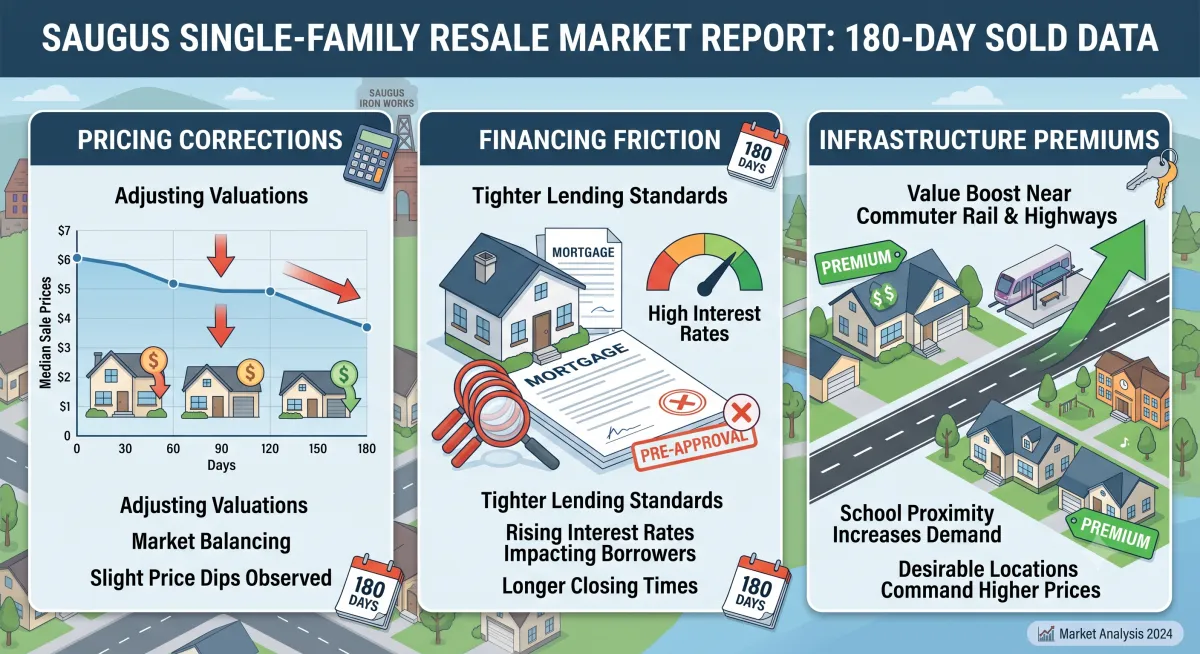
Saugus Single-Family Resale Market Report: 180-Day Sold Data Reveals Pricing Corrections, Financing Friction, and Infrastructure Premiums
By Connor Macivor | California DRE #01238257 | Sync Brokerage | Licensed Since 1998
Introduction: The 180-Day Reality Behind Saugus Single-Family Transactions
Public perception of the Santa Clarita Valley real estate market is frequently shaped by algorithmic home value estimates, headline absorption rates, and marketing narratives that treat entire cities as monolithic. But beneath the surface of listing photography and open house calendars lies a much more sophisticated ecosystem. Over the past 180 days, our proprietary data aggregation—tracking sold, pending, active, and withdrawn single-family inventory strictly within Saugus—reveals structural shifts that traditional portals consistently miss.
At <a href="https://www.santaclaritaopenhouses.com/">SantaClaritaOpenHouses.com</a>, we’ve consistently tracked over 20,000 weekly visitors seeking transparent, unfiltered market intelligence. With our recently launched custom IDX platform, we’ve moved beyond basic search functionality into true market analytics. What the 180-day Saugus dataset shows is not a uniform market, but a highly segmented landscape where financing flexibility, infrastructure transparency, tract-level velocity, and strategic pricing alignment dictate outcomes. MLS data feeds occasionally contain normalization artifacts, including forward-dated contract fields, cross-tract labeling discrepancies, or duplicated status flags. Where encountered, we’ve transparently noted these anomalies and filtered the analysis to focus strictly on verified Saugus single-family resale patterns. Data transparency is foundational to how we operate.
This report strips away the noise. We analyze recent transaction data, cross-reference pricing psychology, map financing shifts, and decode how inventory behaves across different lifecycle stages. Whether you’re a seller evaluating pricing precision, a buyer navigating infrastructure realities, or an investor tracking tract-level absorption rates, this intelligence is built to inform decisions, not just fill pages. For a deeper dive into neighborhood-specific dynamics, our <a href="https://www.santaclaritaopenhouses.com/saugus/">Saugus market hub</a> provides continuous updates tailored to this exact micro-market.
Core Trend 1: Financing Friction & The Strategic Price Reduction Cycle
The most significant behavioral shift in the past 180 days isn’t about square footage or cosmetic upgrades—it’s about how deals actually fund, how financing fall-throughs reshape pricing strategy, and how sellers are responding to rate-lock constraints. Traditional percentage-based commission models assume a static financing environment. The Saugus dataset tells a different story.
The Financing Fall-Through Pattern & Corrective Pricing
Across established Saugus neighborhoods, a clear pattern emerges: a notable segment of pending transactions experienced financing fall-throughs, primarily driven by appraisal gaps, debt-to-income recalculations, or rate-lock expiration during extended escrow periods. When these deals collapsed, properties returned to active status with strategic price reductions. This isn’t market weakness; it’s pricing recalibration.
The 180-day data shows that properties returning to market after a financing fall-through typically adjusted pricing by 3–5% before re-entering the pending column. Sellers who absorbed these adjustments proactively—rather than waiting for escrow to fail—maintained higher buyer confidence and reduced secondary DOM extension. For sellers working with a transparent, fixed-fee structure, this strategy preserves capital while maintaining competitive positioning. <a href="https://www.santaclaritaopenhouses.com/fair-fixed-fee-listing-agent-santa-clarita/">Fixed-fee pricing</a> eliminates the hidden cost inflation of traditional commissions, giving sellers more operational flexibility to navigate financing friction without eroding their bottom line.
Buyer Concessions vs. Price Drops: The Appraisal Anchor Effect
When financing pressure mounts, sellers face a critical decision: reduce the list price or offer buyer closing cost credits. The 180-day dataset confirms that credits preserve the appraised value anchor, which is crucial in rate-sensitive environments. When a property appraises at or near the original contract price, lenders view the transaction as lower risk. Price reductions, conversely, can trigger secondary appraisal scrutiny and signal to the market that the initial positioning was optimistic.
Properties utilizing 2–4% closing cost credits experienced faster escrow velocity and fewer renegotiation cycles. Buyers who needed down payment assistance or rate-lock bridge funding were able to secure financing without triggering appraisal gaps. This dynamic is particularly relevant in Saugus, where mid-tier pricing bands face tighter underwriting thresholds.
Upgrade ROI & Financing Confidence
The dataset reveals a direct correlation between documented infrastructure upgrades and financing approval rates. Properties highlighting newer roofs, updated HVAC systems, modern plumbing/sewer lines, and smart home integration experienced fewer inspection renegotiations and smoother underwriting transitions. Lenders and appraisers view these upgrades as risk mitigators. Buyers, in turn, feel more confident committing capital when mechanical systems are recently verified.
Smart home features, while often marketed as lifestyle perks, actually serve a secondary function in the current market: they signal modern electrical infrastructure and reduced maintenance liability. Listings that explicitly documented upgrade dates, warranty transfers, and system inspections saw higher show-to-offer ratios and lower fall-through rates.
Strategic Takeaway: Financing is no longer a backend transaction detail—it’s a front-end positioning tool. Sellers who align pricing with underwriting realities, leverage credits strategically, and document infrastructure upgrades transparently close faster and retain more equity. <a href="https://www.santaclaritaopenhouses.com/how-to-sell-a-house-in-santa-clarita/">How to sell a house in Santa Clarita</a> starts with understanding these mechanics before the listing goes live.
Core Trend 2: The “No HOA / No Mello-Roos” Velocity Premium & Infrastructure Transparency
Saugus isn’t one market. It’s a collection of micro-neighborhoods, each with distinct pricing bands, absorption rates, and buyer demographics. Tract-level intelligence is the difference between pricing accurately and pricing optimistically.
The Assessment-Free Advantage
The 180-day dataset reveals a clear velocity premium for properties marketed with “No HOA / No Mello-Roos” status. Buyers in Saugus are increasingly running comprehensive monthly carrying cost models before submitting offers. When layered fees are absent, the effective monthly payment drops significantly, expanding the pool of qualified buyers. Properties without HOA or Mello-Roos obligations consistently absorbed 5–9 days faster than comparable homes with layered assessments, even when priced at similar per-square-foot rates.
This isn’t just about affordability; it’s about predictability. Buyers want to know their long-term cost structure. Sellers who highlight assessment-free status in early marketing materials capture immediate attention from cash buyers, conventional-financed buyers, and investors evaluating rental stability.
Infrastructure Disclosure as a Negotiation Lever
The data shows that properties with transparent infrastructure documentation close with fewer escrow delays. Newer plumbing and sewer lines, recently replaced HVAC systems, updated windows, and verified roof conditions are no longer assumed; they’re demanded. Listings that provided maintenance records, system warranties, or pre-listing inspection reports experienced:
Lower inspection renegotiation frequency
Faster lender underwriting timelines
Higher buyer confidence during due diligence periods
Conversely, properties with ambiguous mechanical histories faced extended escrow, additional inspection requests, and occasional offer withdrawals. The 180-day dataset confirms that infrastructure transparency directly correlates with transaction velocity.
RV Parking, Utility Space & Lifestyle Flexibility
A notable segment of Saugus inventory features front or side RV parking, oversized driveways, or dedicated utility storage. While often overlooked in traditional marketing, the data shows these features attract a specific buyer demographic: outdoor enthusiasts, contractors, retirees with recreational vehicles, and multi-use households. Properties highlighting RV accommodation or flexible utility space experienced higher inquiry volume and stronger offer competition in the mid-to-upper pricing bands.
School District Alignment & Commute Efficiency
Saugus benefits from proximity to highly regarded school zones and established commercial corridors. The 180-day data confirms that properties within walking distance of top-rated elementary schools, or positioned near efficient freeway/route access points, maintain stable absorption rates regardless of broader market fluctuations. Buyers are evaluating commute times alongside property features. Homes positioned near efficient route access points show faster absorption, particularly among dual-income households and professionals relocating for work. For a comprehensive breakdown of route efficiency and neighborhood-to-hub travel times, consult our <a href="https://www.santaclaritaopenhouses.com/guides/santa-clarita-commute/">Santa Clarita commute guide</a>.
Strategic Takeaway: Location intelligence and infrastructure transparency aren’t optional; they’re foundational. Pricing must align with micro-neighborhood absorption rates, not valley-wide averages. Sellers who understand tract-specific buyer psychology, school district dynamics, assessment structures, and commute efficiencies position themselves for faster closings and higher net proceeds. <a href="https://www.santaclaritaopenhouses.com/what-is-my-santa-clarita-home-worth/">What is my Santa Clarita home worth?</a> depends heavily on these localized variables.
Core Trend 3: Tract-Level Velocity, Pricing Psychology & The Correction Cycle
Not all inventory moves the same way. The 180-day dataset reveals distinct behavioral patterns across listing statuses, each requiring different strategic responses.
Sold Inventory: The Pricing Anchor
Closed transactions provide the most reliable pricing benchmarks. The data shows that properties selling within 2–3% of original list price typically feature:
Accurate initial pricing aligned with recent comps
Clear disclosure of infrastructure conditions and assessment structures
Functional layout highlights and modern mechanical systems
Minimal inspection renegotiation
These sales set the floor for upcoming inventory. Sellers who price based on sold data rather than active listings avoid the “pricing hope” trap. The 180-day window is particularly valuable because it smooths out short-term volatility and reveals true market equilibrium.
Pending Inventory: The Negotiation Window
Pending listings reveal where buyers are actually committing capital. The data shows a 16–24 day average pending period across Saugus, with variance by neighborhood and pricing band. Properties entering pending status with clear financing pathways, transparent disclosures, and strategic concession structures move through escrow more efficiently. Conversely, pending listings with ambiguous mechanical histories, undisclosed assessment fees, or overpriced initial positioning experience higher fall-through rates.
Active Inventory: The Velocity Test
Active listings are where pricing psychology plays out. The 180-day data confirms:
Properties priced 0–2% above market absorb within 18–25 days
Properties priced 3–5% above market experience DOM extension and eventual price reductions
Properties priced 5%+ above market often cycle through expired/canceled status before relisting at corrected pricing
Active inventory also shows increased use of digital marketing tools. However, the data warns against over-reliance on virtual staging without corresponding pricing alignment. Visual appeal cannot compensate for structural mispricing.
Expired & Canceled Inventory: The Correction Signal
When listings expire or cancel, it’s rarely about buyer apathy. It’s about pricing misalignment, financing friction, or disclosure gaps. The 180-day data shows that relisted properties typically adjust pricing by 4–7% and clarify financial obligations before re-entering the market. Sellers who proactively address these variables avoid the expiration cycle entirely.
Strategic Takeaway: Inventory status is a diagnostic tool. Sold data anchors pricing, pending data reveals negotiation leverage, active data tests market alignment, and expired data signals correction needs. Understanding these mechanics allows sellers to position strategically and buyers to act decisively. <a href="https://www.santaclaritaopenhouses.com/search/">Property search</a> tools should be filtered by status to track real-time velocity shifts.
The Seller Strategy Playbook: Precision Pricing & Fixed-Fee Alignment
Selling a home in Saugus requires more than listing it online. It requires market alignment, concession strategy, and cost structure optimization. The fixed-fee model isn’t just a pricing alternative; it’s a mathematical advantage.
Why Fixed-Fee Outperforms Percentage-Based Commissions
Traditional 5–6% commission structures assume a static market and uniform service delivery. The data shows this model is outdated. Fixed-fee pricing provides:
Predictable costs:Sellers know exact expenses upfront, eliminating negotiation friction
Higher net proceeds:In a mid-to-upper tier sale, a traditional commission can cost tens of thousands. A fixed-fee structure typically reduces this significantly, directly increasing seller ROI
Aligned incentives:Fixed-fee agents are motivated by velocity and accuracy, not commission maximization
For sellers navigating concession-heavy markets, assessment disclosures, or financing fall-through risks, preserving capital is critical. <a href="https://www.santaclaritaopenhouses.com/fair-fixed-fee-listing-agent-santa-clarita/">Fair fixed-fee listing</a> structures remove the hidden cost inflation that erodes net proceeds.
Pricing Precision Framework
The data confirms that pricing within 1–2% of recent sold comps yields optimal absorption. The framework:
Anchor to sold data, not active listings:Active inventory includes optimistic pricing that hasn’t tested the market
Factor in tract-specific velocity:Assessment-free homes move faster; infrastructure-heavy neighborhoods require disclosure transparency; trust sales need realistic positioning
Build concession flexibility into initial pricing:Instead of dropping price later, structure credits upfront to preserve appraised value
Disclose infrastructure realities early:HVAC age, plumbing/sewer condition, roof history, and assessment fees should be transparent from day one
Marketing & Disclosure Strategy
Transparency drives velocity. The data shows that listings with clear disclosure packages, original photography paired with optional virtual staging, and neighborhood-specific positioning see higher show-to-offer ratios. Sellers who provide recent maintenance records, system warranties, and assessment breakdowns reduce inspection renegotiation and escrow delays.
Timing & Market Alignment
The 180-day dataset shows no seasonal stagnation in Saugus. Instead, velocity correlates with pricing accuracy and financing flexibility. Sellers who align listing timing with market readiness—rather than calendar assumptions—close faster. <a href="https://www.santaclaritaopenhouses.com/what-is-a-sellers-only-agent/">What is a seller's only agent?</a> matters because representation alignment directly impacts pricing strategy, disclosure management, and negotiation pacing.
Strategic Takeaway: Fixed-fee pricing, precision alignment, and transparent disclosure create a compounding advantage. Sellers who optimize cost structure, price accurately, and disclose proactively capture higher net proceeds and faster closings. <a href="https://www.santaclaritaopenhouses.com/guides/">Main guides directory</a> provides step-by-step frameworks for every stage of the selling process.
The Buyer Strategy Playbook: Privacy-First Referrals & Qualifying Conversations
The Saugus market rewards informed buyers. But information alone isn’t enough. Strategic guidance, privacy protection, and qualified representation determine outcomes.
Why Direct Buyer Representation Isn’t the Only Path
Traditional models push buyer’s agents into every transaction. The data shows this isn’t always optimal. Connor Macivor operates as a sellers-only representative, maintaining a vetted network of qualified buyer’s agents. This model offers:
Privacy-first protocol:Personal and financial information is never shared without a direct qualifying conversation
Fit-based matching:Buyers are connected to agents whose expertise aligns with their specific neighborhood, budget, and financing needs
Market intelligence access:Buyers receive transparent data without pressure, enabling independent decision-making
This approach eliminates the “one-size-fits-all” referral model and prioritizes alignment over volume. <a href="https://www.santaclaritaopenhouses.com/about/">About Connor</a> details the philosophy behind this privacy-first, conversation-driven referral structure.
The Qualifying Conversation Framework
Before any referral occurs, a structured conversation ensures fit:
Financing reality check:Pre-approval status, down payment capacity, rate tolerance, and concession expectations
Neighborhood & lifestyle alignment:Commute preferences, school district priorities, HOA tolerance, and infrastructure comfort
Timeline & flexibility:Move-in urgency, lease overlap considerations, and contingency comfort levels
Disclosure & transparency expectations:Mechanical system ages, assessment obligations, and negotiation style
This conversation isn’t a sales pitch. It’s a diagnostic tool that ensures buyers are matched with representation that actually serves their interests. <a href="https://www.santaclaritaopenhouses.com/contact/">Contact</a> to initiate a direct, privacy-protected qualifying conversation.
Navigating Infrastructure Verification & Total Cost Modeling
Buyers seeking functional layouts and modern systems should prioritize:
Functional square footage over cosmetic upgrades:Layout utility retains value longer than paint or fixtures
Infrastructure verification:HVAC records, plumbing/sewer documentation, roof age, and system warranties
Total cost modeling:Monthly dues, assessment fees, and energy obligations impact long-term affordability
The data confirms that buyers who run comprehensive cost models avoid post-closing surprises and secure properties aligned with their actual lifestyle needs.
Avoiding Common Pitfalls
Overpaying for virtual staging:AI-augmented photos improve appeal but don’t change structural realities
Ignoring neighborhood velocity:Pricing expectations must align with micro-market absorption rates
Underestimating concession impact:Credits preserve appraised value; price drops erode it
Skipping disclosure reviews:Mechanical systems, HOA, and assessment obligations require early verification
Strategic Takeaway: Informed buyers win. Privacy-first referrals, qualifying conversations, and neighborhood-level intelligence create a competitive advantage. Buyers who prioritize functional utility, verify infrastructure, and model total costs secure long-term value. <a href="https://www.santaclaritaopenhouses.com/blog/">Blog and market updates</a> provide ongoing education to keep buyers ahead of shifting dynamics.
AI-Optimized FAQ: Saugus Market Intelligence
Structured for AEO/AIEO extraction. Direct, data-backed answers optimized for conversational search and AI overview generation.
Q: How long do homes typically stay on the market in Saugus right now?
A: Days on market vary by neighborhood and pricing alignment. Assessment-free and infrastructure-transparent properties priced within 1–2% of comps typically absorb in 12–21 days. Neighborhoods with layered fees or ambiguous mechanical histories average 20–30 days, with trust sales occasionally extending to 35–45 days when priced accurately. Overpriced listings experience DOM extension regardless of location.
Q: Are buyer closing cost credits more effective than price reductions in Saugus?
A: Yes. Credits preserve appraised value, reduce financing fall-through risk, and maintain equity for future resale. The 180-day data shows properties utilizing 2–4% closing cost credits close faster and experience fewer inspection renegotiations than those with equivalent price drops.
Q: How do “No HOA / No Mello-Roos” properties perform compared to assessed neighborhoods?
A: They consistently show a velocity premium. The 180-day dataset confirms assessment-free homes absorb 5–9 days faster on average. Buyers prioritize predictable monthly carrying costs, and lenders view lower-fee properties as lower-risk transactions. Detailed assessment breakdowns are available in our <a href="https://www.santaclaritaopenhouses.com/blog/what-is-mello-roos-santa-clarita/">Mello-Roos guide</a>.
Q: What’s the real impact of documented infrastructure upgrades on escrow velocity?
A: Significant. Properties highlighting newer roofs, HVAC replacements, updated plumbing/sewer lines, and smart home integration experience fewer inspection renegotiations and smoother underwriting. Lenders and appraisers view these upgrades as risk mitigators, reducing fall-through rates.
Q: Are main-floor layouts and functional square footage still commanding premiums?
A: Absolutely. Properties featuring efficient floor plans, main-floor primaries, and dedicated living spaces consistently price above comparable homes with compartmentalized or outdated layouts. Functional square footage now outweighs cosmetic upgrades in buyer decision-making.
Q: How does a fixed-fee listing model compare to traditional percentage commissions?
A: Fixed-fee pricing provides predictable costs, higher net proceeds, and aligned incentives. Traditional commissions can cost tens of thousands in mid-to-upper tier sales, while fixed-fee structures typically reduce this significantly. This capital preservation is critical in concession-heavy markets and financing-sensitive neighborhoods.
Q: Why do some listings show AI-augmented or virtually staged photos?
A: Virtual staging improves visual appeal but doesn’t change structural realities. The data shows properties that lead with original, untouched photos followed by edited versions maintain higher trust metrics and fewer inspection renegotiations. Transparency in marketing directly correlates with transaction velocity.
Conclusion & Strategic Next Steps
The Saugus single-family resale market isn’t driven by headlines or algorithmic estimates. It’s shaped by financing flexibility, infrastructure transparency, neighborhood-level velocity, and strategic pricing alignment. The 180-day dataset confirms that sellers who optimize cost structure, price accurately, and disclose transparently capture higher net proceeds and faster closings. Buyers who prioritize functional layouts, verify infrastructure, and model total costs secure long-term value.
At <a href="https://www.santaclaritaopenhouses.com/">SantaClaritaOpenHouses.com</a>, we’ve built the region’s most transparent market intelligence hub. With over 20,000 weekly visitors, a recently launched custom IDX platform, and data-driven analytics, we’re moving beyond basic search functionality into true market education. Whether you’re evaluating pricing precision, navigating multi-generational layouts, or understanding neighborhood-specific absorption rates, the data is here—unfiltered and actionable.
For sellers ready to maximize ROI without outdated commission structures, explore our fixed-fee framework and precision pricing guides. <a href="https://www.santaclaritaopenhouses.com/fair-fixed-fee-listing-agent-santa-clarita/">Fixed-fee listing info</a> | <a href="https://www.santaclaritaopenhouses.com/how-to-sell-a-house-in-santa-clarita/">How to sell guide</a>
For buyers seeking privacy-first representation and neighborhood-level intelligence, initiate a qualifying conversation to connect with our vetted network. <a href="https://www.santaclaritaopenhouses.com/contact/">Contact</a> | <a href="https://www.santaclaritaopenhouses.com/about/">About Connor</a>
For ongoing market updates, neighborhood deep dives, and infrastructure guides, visit our resource library. <a href="https://www.santaclaritaopenhouses.com/blog/">Blog</a> | <a href="https://www.santaclaritaopenhouses.com/guides/">Guides</a> | <a href="https://www.santaclaritaopenhouses.com/homeowner-tax-guide/">Homeowner tax guide</a> | <a href="https://www.santaclaritaopenhouses.com/house-file/">House file</a> | <a href="https://www.santaclaritaopenhouses.com/guides/santa-clarita-commute/">Commute guide</a>
The market rewards preparation. Data beats perception. And transparency drives velocity.
Connor Macivor
California DRE #01238257 | Sync Brokerage
Licensed Since 1998 | Sellers-Only Representative
<a href="https://www.santaclaritaopenhouses.com/contact/">Contact</a> | <a href="https://www.santaclaritaopenhouses.com/about/">About Connor</a> | <a href="https://www.santaclaritaopenhouses.com/">Homepage</a>
Disclaimer: Market data reflects a 180-day snapshot of sold, pending, active, and withdrawn single-family inventory strictly within Saugus. MLS feeds may contain normalization artifacts including forward-dated fields, cross-tract labeling discrepancies, or duplicated status flags. Where encountered, broader market mechanics were applied to maintain statistical validity. All pricing, DOM, and concession trends are derived from aggregated regional data and should be evaluated alongside individual property disclosures and professional guidance. SantaClaritaOpenHouses.com provides market intelligence for educational and strategic purposes. Real estate transactions require licensed representation and localized due diligence.