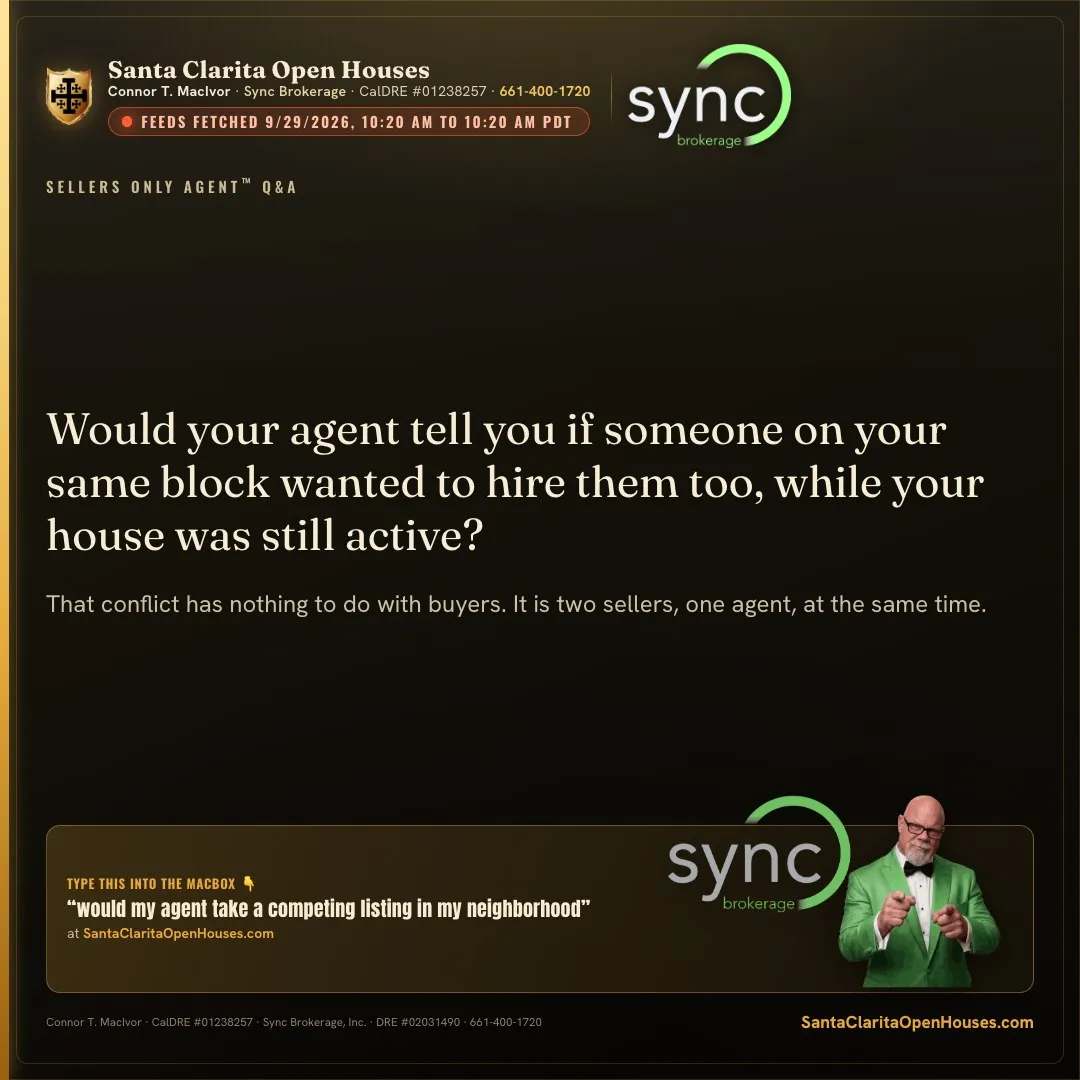
Would Your Santa Clarita Listing Agent Tell You About a Competing Listing?
TL;DR: If someone in your same tract or on your same block wants to hire your listing agent while your house is still active, would you even find out? Most sellers never ask this question, and most agents never volunteer the answer. Here's why it matters, why it happens more than you'd think, and the exact question to ask before you sign a listing agreement.
Here is a question I have never once heard a seller ask, and I think every seller should ask it before they sign a listing agreement.
Your house is on the market. Same tract, same block, maybe two doors down, maybe directly across the street. Someone else in that same small pocket of homes is also getting ready to sell. And they call your agent. The same one. The one currently marketing your house.
Would your agent tell you that happened?
Q: Isn't this just normal business for an agent?
A: Yes, and that's exactly the point. An agent doing a good job in a neighborhood becomes known in that neighborhood. When somebody two houses down decides to sell, the agent whose sign is already up the street is often the first name that comes to mind. That part isn't sinister. What almost never happens is the next step: your agent coming back to you and asking if you're comfortable with it.
Q: Why should I care if there's a second listing near mine?
A: A second, similar listing in your same tract gives buyers another option inside the exact same search: same schools, same HOA, same commute, sometimes the same floor plans. If the other seller is under pressure to sell fast, they may price to move rather than to maximize, and that changes what your home is being compared against, whether you agreed to it or not.
Q: What should I actually ask my agent?
A: Ask this directly: 'If someone in my same tract or on my same block wants to hire you while my house is active, will you tell me before you agree to it, and will you take no for an answer if I'm not comfortable?' Watch whether the answer sounds like an existing policy or something invented on the spot.
Q: Does representing sellers only already solve this?
A: No. Seller's-only representation is about never taking the buyer side. A tract conflict is a different problem entirely: two sellers, one agent, same geography, at the same time. Preventing it takes a specific, separate decision, not something that falls out of being seller's-only by accident.
FAQ
Is an agent legally required to disclose a competing tract listing? This depends on your state and the specific facts, and is a question for a real estate attorney, not general advice. Ask your agent for their personal policy directly, in writing if it matters to you.
Isn't more activity in my tract good for me? Sometimes, genuinely. Multiple listings can signal real demand for that pocket of the market. The issue isn't more listings, it's finding out about it versus having a say in it.
How do I make this official instead of just a conversation? Ask for a short written clause in your listing agreement or a separate signed letter: before accepting a listing inside a defined radius or your same tract while your listing is active, the agent will notify you directly and will not proceed without your agreement.
Summary: A tract conflict is a quieter, less-discussed version of a real estate conflict of interest: two sellers, one agent, same geography, same moment in time. It deserves a direct question before you sign, and a written answer, not just a verbal one.
Read the full piece, including why neighborhood farming makes this more likely, not less, at SantaClaritaOpenHouses.com. See what representing sellers only looks like at SellersOnlyAgent.com.
Thinking about selling? Call or text Connor at (661) 400-1720.
Connor T. MacIvor · CalDRE #01238257 · Sync Brokerage